


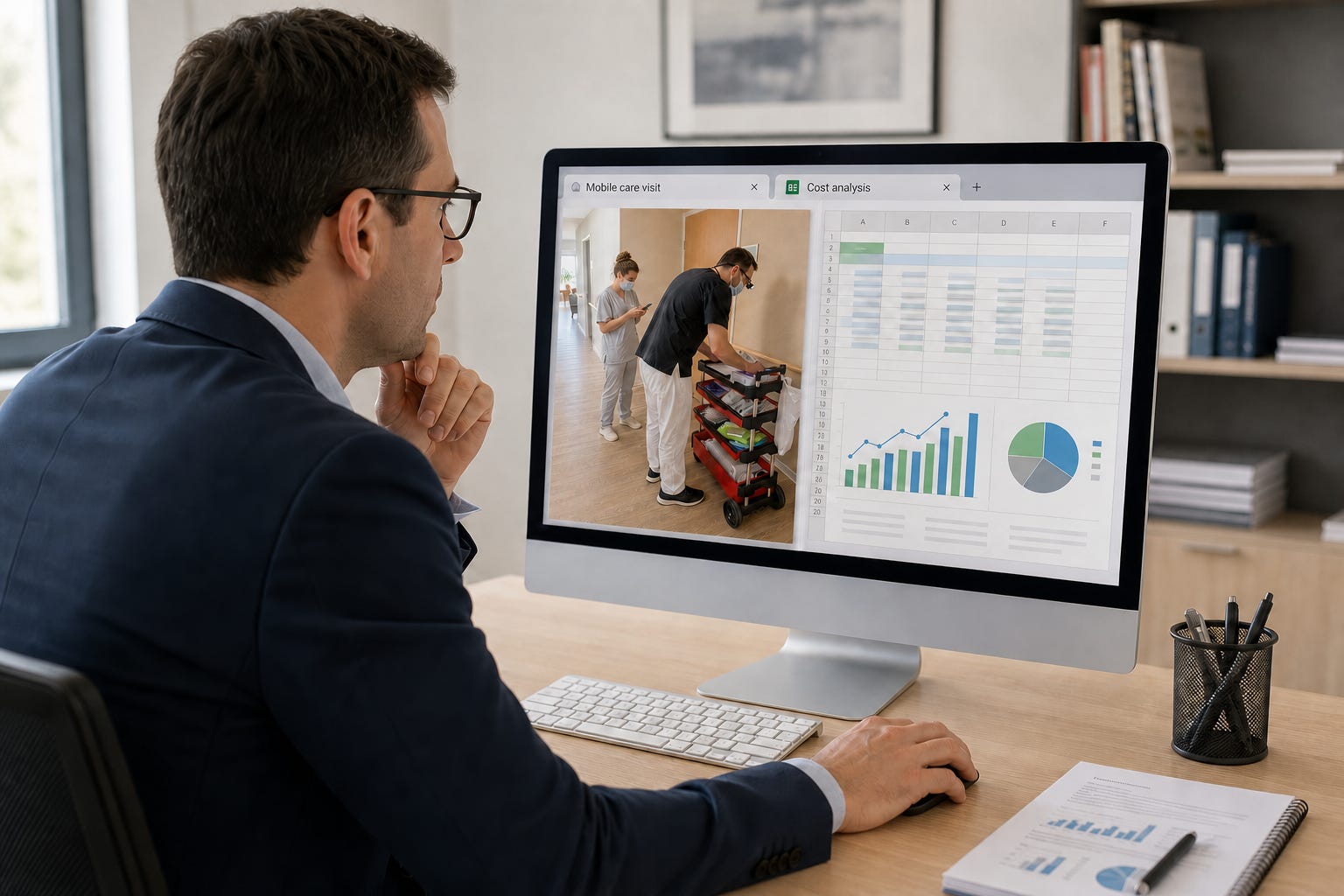
At the London School of Economics, I learned to look at healthcare through models: costs, outcomes, incentives and trade-offs.
At a Großvisite in a German care home, I learned what those models leave outside the frame.
A Großvisite is a scheduled visit in which the dental team moves through the care home and carries out routine checks for residents. The rhythm is practical. We knock, introduce ourselves, adapt to the room and to the person in front of us, examine, explain and move on. The dental equipment travels with the clinicians rather than asking residents to travel to it.
What stayed with me was not a dramatic procedure. It was the atmosphere around ordinary care. Frau Neumann brightened when the dentist asked how she was getting on with her prosthesis; she was proud that it felt comfortable again. Herr Müller had several questions ready, then stayed for the pleasure of the conversation. Their gratitude appeared in small forms: a smile, a joke, a careful description of what felt different when chewing.
On a spreadsheet, these moments are difficult to enter into a cell. In the room, they were part of the value of the visit.
A note on Frau Neumann and Herr Müller: both are composite characters created from recurring impressions during mobile-care visits. Their names and personal details are invented, and neither represents an identifiable patient. These scenes are illustrative, not an evaluation of outcomes.
The cost model changed at the resident’s door
Before the visit, I might have compared two delivery models by starting with the dental appointment itself. In one model, a patient goes to a practice. In the other, the dentist goes to the patient. The second can appear more expensive because professional time is spent travelling and equipment must be portable.
That comparison is too narrow.
For a resident with limited mobility, reaching a dental practice may require a care worker or relative, a suitable vehicle, coordination with medication and personal-care routines, and sometimes non-emergency patient transport. In the care home, I could see why that journey may be stressful for someone living with dementia, severe disability or several health conditions. It is a great deal of disruption for a routine check, and policies for older people increasingly recognise the value of bringing suitable care closer to where people live (OECD, 2025).
Those resources are real even when they do not appear on the dentist’s invoice. A relative’s time, a care worker’s absence from the ward, transport capacity, waiting and the resident’s distress all belong to the pathway. If an economic analysis counts only the provider’s bill, it can make a costly pathway look cheap by moving costs to families, care facilities or another budget.
Mobile care can avoid a journey and some of the time around it when an on-site visit is a safe substitute for a practice appointment (OECD, 2025). But the qualification matters. Not every dental procedure belongs in a care-home room, and not every resident can or should be treated there. Infection control, lighting, equipment, clinical risk, consent and the need for imaging or more complex intervention all shape the decision (Borg-Bartolo et al., 2020). Mobile care is not a universal replacement for the practice. It is an additional route that may create more value for the right patient and task.
The relevant economic question is therefore not, ‘Which appointment is cheaper?’ It is, ‘Which complete pathway achieves the outcome that matters, with the least burden and the best use of resources?’
Some outcomes become visible only when you are close enough
Economists like measurable outcomes for good reasons. Measurement makes alternatives comparable and claims contestable. Yet the Großvisite made me notice how quickly measurement can shrink the purpose of care.
Oral health is not only the absence of disease. The World Health Organization describes it in terms that include eating, speaking, self-confidence, well-being and the ability to socialise without pain or embarrassment (WHO, 2026). That wider definition matched what I saw. Frau Neumann’s prosthesis supported eating, but her ease in talking about it also suggested something more personal: confidence. Herr Müller’s questions reminded me that a routine visit can detect a problem and give a resident a direct conversation with a professional.
These are not sentimental extras added after the ‘real’ clinical outcome. They are reasons the clinical outcome matters.
The residents’ reactions also changed my understanding of access. Access is often measured by whether a service exists, is covered or was used. Those measures are necessary, but they do not fully describe care that reaches someone in a familiar place, at a manageable pace and with enough time for a question. A service can be technically available and still impose a pathway that a frail person cannot comfortably navigate.
Nor should one positive visit be turned into population evidence. I cannot infer improved quality of life from gratitude in a room. What I can infer is that our evaluation should ask about more than completed examinations. If we study mobile care, we should measure patient-reported comfort and experience, ability to eat, avoided transport, staff time, follow-up, clinical outcomes and the full cost of delivery. Proximity does not replace evidence. It tells us which evidence may be missing.
Value is negotiated among several people
My training encouraged me to look beyond traditional decisions based only on clinical effectiveness or the smallest immediate expenditure. Value-based decision-making asks how outcomes that matter to patients relate to the resources used across the pathway. The European Commission’s expert panel widened the concept further, distinguishing personal, technical, allocative and societal value (European Commission Expert Panel, 2019).
The distinction matters in a care home because no single stakeholder can define the answer alone.
The resident can tell us whether the care is tolerable, understandable and relevant to daily life. The dentist judges what is clinically safe and feasible. Care-home staff understand routines, capacity and the resident’s behaviour over time. Relatives or legal representatives may support history, consent and continuity. Insurers and policymakers shape reimbursement. Operators see whether a theoretically attractive process can work repeatedly on a Tuesday morning.
These perspectives can conflict. A resident may value remaining in their room. A dentist may need equipment available only in the practice. A care home may welcome fewer external journeys but struggle to release staff during the visit. A payer may see the dental fee but not the transport or care time saved elsewhere. Value-based care does not make these trade-offs disappear. It gives us a better table around which to discuss them.
This is also why mobile care cannot be designed by dentists alone, or by economists alone. A qualitative study in two rural German care homes, involving eleven professional stakeholders, found that access, cooperation, incentives, information and equipment all shaped oral healthcare delivery (Gomez-Rossi et al., 2022). Its small, context-specific sample cannot tell us what every care home needs. It does show why an intervention aimed at one professional group can fail when the pathway depends on many.
Ageing turns a local lesson into a system question
The scale of the issue is growing. Germany’s Federal Statistical Office projects that one in four people in the country will be aged 67 or older by 2035, compared with one in five in 2024 (Destatis, 2025). Age does not itself determine dependency. Across OECD countries, however, more than half of people aged 65 and over were living with at least two chronic conditions in 2019, making adaptable, coordinated services increasingly important (OECD, 2025).
Mobile dentistry already exists in several forms. A Swiss survey described private providers using portable equipment and university services operating through different models, while calling for stronger collaboration (Borg-Bartolo et al., 2020). A later Swiss pilot examined 56 care-dependent older people, 47 of them care-home residents, and reported low programme uptake alongside substantial oral-health needs (Borg-Bartolo et al., 2021). That study was small and did not establish that one mobile model is cost-effective. I like it precisely because it resists an easy story: bringing a service closer does not automatically mean people will use it or that implementation will be simple.
For health economics, this creates a practical research agenda. We need comparisons that follow the whole pathway: who receives care, who is missed, which visits are safely completed on site, which require referral, what transport and staff time are avoided, what new costs appear, and whether outcomes and experience improve. We also need distributional questions. Does mobile care reduce unequal access, or does it mainly reach facilities that already organise services well?
The point is not to prove that mobile care always wins. It is to stop evaluating it with a model that ignores the reasons it exists.
Innovation can begin with a better trolley
The most immediate innovation I saw was not artificial intelligence or a new clinical device. It was a trolley.
Our team recently bought a transportable, foldable trolley for mobile visits. Previously, arriving at a care home could begin with a search for a suitable surface: Is a trolley available? Is it clean? Can it carry the instruments safely? The new trolley gives the dental team a predictable workspace, with equipment organised and ready to move from room to room. We have observed smoother set-up and fewer small obstacles before care can begin, although we have not yet measured the time saved.
That modest improvement matters because accessibility depends on more than bringing a dentist through the front door. The service must also be easy to set up and reliable enough to work around residents. Better organisation can help the team spend less attention on searching and carrying, and more attention on the person receiving care.
The trolley also hints at what supportive technology might make possible. A future version could help track supplies, guide packing or follow the dentist between rooms. Perhaps it could one day present a requested instrument. The purpose would be simple: remove practical friction without replacing clinical judgement or human contact. The economic question comes first: Which recurring tasks consume time, and where could technology create enough value to justify its cost?
What I brought back from the Großvisite
I left the care home more convinced of health economics, not less. Scarce resources still require comparison, evidence and trade-offs. But the visit changed what I think belongs in the comparison.
The value of mobile dental care may include a clinical problem detected, a prosthesis that works, a stressful journey avoided, a care worker who remains on the ward and a resident who can ask a question in a familiar room. Its cost includes the dentist’s travel, portable equipment, coordination and all the operational work needed to create a safe treatment environment. Both sides of the equation are broader than a fee schedule.
The trolley reminded me that innovation can begin with close observation of friction. The residents reminded me that outcomes are lived before they are measured. And the care team reminded me that no model of value is complete until the people who deliver and receive care have helped define it.
A spreadsheet can support that decision. It should not be allowed to make the room disappear.
References
Borg-Bartolo, R., H. Amberg, O. Bieri, E. Schirrmann, and S. Essig. 2020. “The Provision of Mobile Dental Services to Dependent Elderly People in Switzerland.” Gerodontology 37: 395–410. https://doi.org/10.1111/ger.12490.
Borg-Bartolo, R., T. von Wyttenbach, M. J. Keller, et al. 2021. “Delivery of Mobile Dental Services to Dependent Elderly People: Results from a Pilot Study in Rural Switzerland.” Swiss Dental Journal 131: 584–593. https://pubmed.ncbi.nlm.nih.gov/33512790/.
Destatis. 2025. “By 2035, One Quarter of Germany’s Population Will Be Aged 67 or Over.” Press release, December 11, 2025. https://www.destatis.de/EN/Press/2025/12/PE25_446_12.html.
European Commission Expert Panel. 2019. Defining Value in ‘Value-Based Healthcare.’ Brussels: European Commission. https://health.ec.europa.eu/publications/defining-value-value-based-healthcare_en.
Gomez-Rossi, J., J. Schwartzkopff, A. Müller, et al. 2022. “Health Policy Analysis on Barriers and Facilitators for Better Oral Health in German Care Homes: A Qualitative Study.” BMJ Open 12: e049306. https://bmjopen.bmj.com/content/12/3/e049306.
OECD. 2025. The Economic Benefit of Promoting Healthy Ageing and Community Care. Paris: OECD Publishing. https://www.oecd.org/content/dam/oecd/en/publications/reports/2025/10/the-economic-benefit-of-promoting-healthy-ageing-and-community-care_7f0491f3/0f7bc62b-en.pdf.
World Health Organization. 2026. “Oral Health.” Accessed August 6, 2026. https://www.who.int/health-topics/oral-health/.