


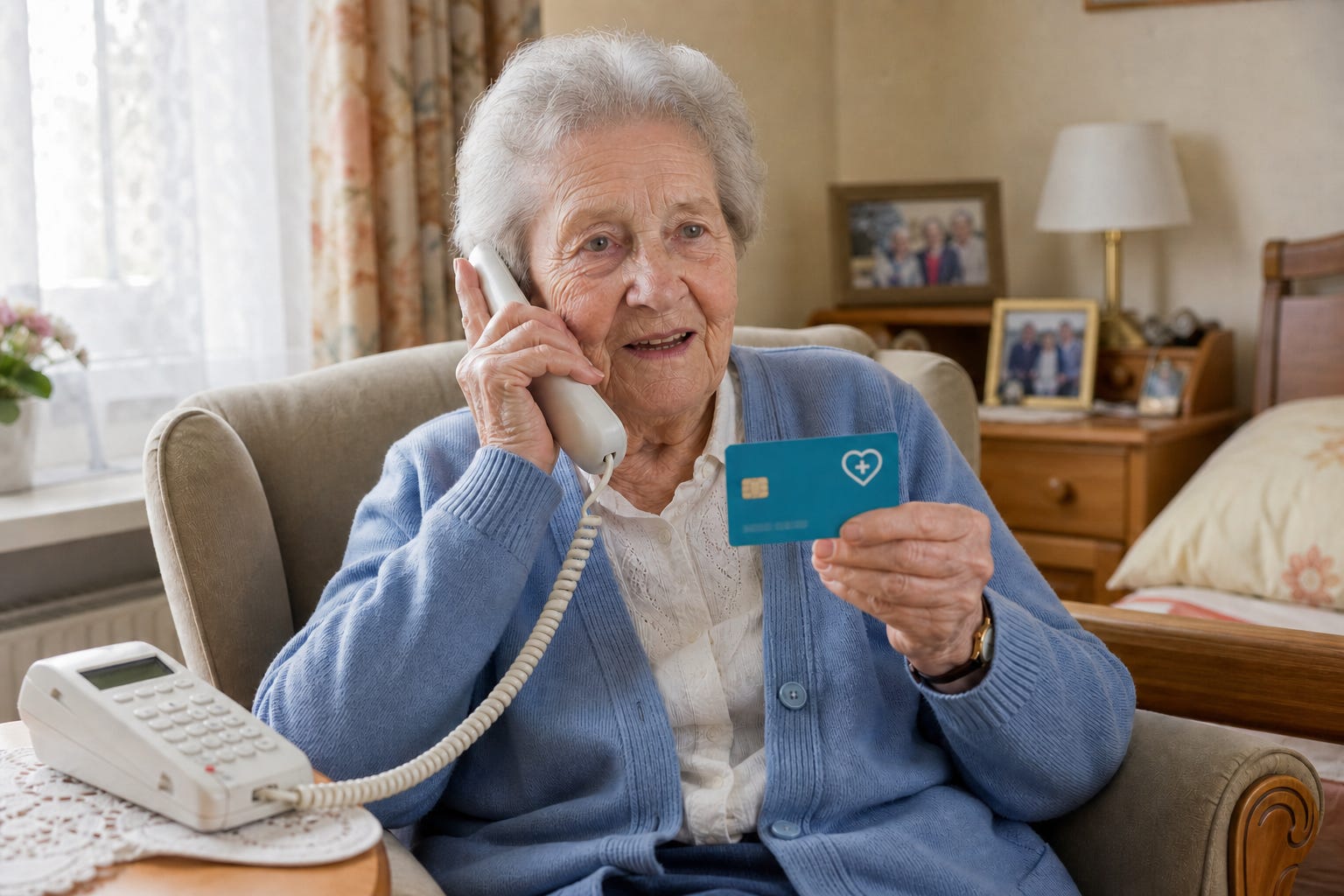
On the clinic schedule, Frau Neumann’s appointment lasted twenty-five minutes.
For her, it began twelve days earlier.
That was when she first noticed that chewing on the left side had become painful. She waited for a few days, hoping it would settle. Then she looked for the card from her dentist, found two cards with similar names, and called the number she thought was right. The practice asked her to describe the problem, find her insurance card and bring an up-to-date medication list. Her daughter arranged time away from work to take her there. The appointment had to fit around a home-care visit and the hours during which Frau Neumann is usually most alert.
By the time she sat in the dental chair, several decisions had already been made and several small problems had already been solved. None of this appeared in the appointment book. The record began when she arrived.
Frau Neumann is a composite character, drawn from situations that recur in the care of older patients. She is not an identifiable patient. The details are invented, but the work is familiar.
In the first Care, Built article, Healthcare Is Discussed From Too Far Away, I wrote about the distance between a pathway on paper and care as it is actually delivered. One of the things that disappears at a distance is the work performed by the patient. We draw an arrow from “problem” to “appointment” and another from “appointment” to “treatment.” Someone still has to move the case along those arrows, and very often that work falls to the person who is ill.
The unofficial coordinator
We tend to divide healthcare work by profession. Doctors diagnose. Nurses monitor. Pharmacists dispense. Therapists rehabilitate. Administrators arrange and document. These categories are visible because people are employed to perform them, time is allocated to them and, in many cases, a code records that they occurred.
The patient’s role is described rather differently. The patient should “seek care,” “attend follow-up” and “adhere to treatment.” Those phrases sound like three simple actions. In practice, they can contain a surprising amount of work. Call it patient work.
The patient notices a change and decides whether it deserves attention. They work out which part of the system is responsible. They find a phone number, call during opening hours and explain the problem in the vocabulary the service expects. They compare appointments with work, childcare or home-care schedules. They obtain a referral, carry information between organisations, repeat a medical history, remember conflicting instructions and notice when nobody has called back.
Afterwards, they may need to collect a prescription, arrange another appointment, monitor symptoms and decide whether a change is expected or alarming. If several conditions are involved, they also become the only person with a view across the whole process.
For a healthy person with flexible work, good health literacy, reliable internet and confidence in the local language, this may be annoying but manageable. That is often the person implicitly imagined when a pathway is designed. The healthcare system gives them a sequence of tasks, and they complete it.
But the need for healthcare does not rise and fall with a person’s ability to manage those tasks. Quite often, the relationship runs in the opposite direction. Illness, pain, fatigue, dementia, depression, poor vision and limited mobility all increase the need for care while reducing the capacity to organise it.
This is particularly clear in mobile dentistry. A resident in a nursing home may not be able to identify the source of pain, call a practice, explain a broken denture, produce a medication list or consent to treatment without support. The work does not disappear. A care worker may notice that lunch has been left untouched. A nurse looks for the medication plan. A relative answers questions about previous treatment. Someone coordinates the visit, makes sure the resident is available and keeps track of a denture if it has to go to a laboratory.
When each of those things happens, the clinical encounter can look simple. When one does not happen, the treatment may never begin.
The same principle applies far beyond nursing homes. A parent trying to organise care for a disabled child, a person recovering from surgery, someone with a new cancer diagnosis or a patient seeing several specialists at once may all spend a significant part of the week managing healthcare. Family members often absorb the work, which makes it less visible rather than less real.
Who disappears before the appointment
There is a selection effect hidden in many healthcare workflows. We mostly see the people who reached the appointment.
The online form was apparently usable because the patients in the waiting room managed to complete it. The telephone system appeared adequate because the people speaking to the receptionist got through. The referral process seemed to function because the specialist saw patients with referrals.
The people who stopped earlier are harder to observe. They may appear later as a missed appointment, delayed treatment or an emergency. Sometimes they do not appear at all. A database showing no treatment cannot usually tell us whether no treatment was needed or whether the path to it quietly failed.
This matters because small obstacles do not affect everyone equally. An extra password, a morning spent calling, a form available only in one language or a request to upload a document may be a minor inconvenience for one person and the point at which another person gives up. Add several such steps together and access begins to depend on persistence, time, literacy and family support as much as on clinical need.
We often describe this as patient behaviour. The person “did not engage,” “failed to attend” or was “lost to follow-up.” Sometimes that description is fair; people can make choices that professionals would not recommend. But it can also conceal a design decision. Before concluding that a patient failed to comply with a pathway, it is worth asking how much project management the pathway demanded from them.
Formal coverage can therefore overstate practical access. A service may be included in insurance, located somewhere in the city and technically available. Yet receiving it still depends on a series of successful handovers, many of which are assigned to the patient without ever being named as such.
A case: the subsidy that must be applied for
Germany’s hardship protection for dental prostheses offers a particularly clear example.
As of 2026, statutory health insurance ordinarily pays a fixed subsidy equal to 60 per cent of the average cost of a defined standard treatment. For patients on very low incomes, the Härtefallregelung raises that subsidy to 100 per cent. If the patient chooses the standard treatment, the insurer covers its full cost. The arrangement is still often called the doppelter Festzuschuss, although the additional subsidy is now 40 rather than another 60 percentage points. It is a sensible protection: lack of money should not become lack of teeth. (KZBV, 2026)
But the protection does not activate itself. The insurer has to establish that the patient qualifies, which generally requires an application and evidence of income or receipt of a qualifying benefit. For an independent patient, this may mean one form and a few supporting documents. In a nursing home, the same request can expose a much larger problem: who is responsible for making it happen?
A resident with advanced dementia may not understand the subsidy, know where a pension or social-assistance notice is kept or be able to sign. A nurse may know that new dentures are needed but have neither the documents nor the legal authority to act. The dental practice may not know whether a relative, an authorised representative, a court-appointed guardian or the facility’s social service handles the resident’s finances. The relative may live in another city. The insurer, reasonably, waits for proof.
There may be only a few sheets of paper. The work lies in finding the person who is both able and authorised to submit them.
The available evidence suggests that the protection is useful once it has been activated. In an analysis of 404,610 AOK Nordost members aged 75 or older, having recognised social-hardship status was associated with higher use of prosthetic services (adjusted OR 1.19; 95% CI 1.17–1.21). The association is consistent with hardship protection reducing financial barriers once the status has been recognised. (Hempel et al., 2020)
It also changes how I read research I helped to conduct before building SwissMedAI. In a separate analysis of the same population, my co-authors and I examined how age, health, geography and social-hardship status were associated with wider dental-service use. The hardship variable appeared in the data as a clean administrative fact. It allowed us to study people whose status had been established; it could not distinguish a person who was ineligible from one who qualified but never completed the process. (Schwendicke et al., 2021)
Administrative data record recognised eligibility more readily than unrealised entitlement. If protection depends on a successful application, the people least able to apply can disappear from the variable intended to identify vulnerability.
Evidence from a neighbouring German benefit shows why that blind spot deserves attention. Buslei and colleagues estimated that around three in five households eligible for old-age basic-income support were not receiving it, with non-take-up especially high among older and widowed people. They discussed limited information, small expected benefits, stigma and procedural complexity as possible explanations. (Buslei et al., 2019)
That figure is not an estimate for the dental Härtefallregelung. I have not found a robust dental-specific estimate of how many eligible patients fail to obtain it. The comparison establishes a narrower point: a legal entitlement that depends on an application will not necessarily reach everyone who qualifies. In a qualitative study I co-authored in German care homes, dementia, disability, information exchange and cooperation among residents, carers, relatives and dental professionals all shaped whether oral care could be delivered. The study did not examine subsidy applications, but it described the human network through which one has to pass. (Gomez-Rossi et al., 2022)
Seen from the insurer’s office, asking for a few documents is proportionate. Seen from the resident’s room, those documents may sit at the end of a chain involving the dentist, nursing staff, social services, a relative and a legal representative. If nobody owns the chain, a benefit designed for the most vulnerable becomes easiest to obtain for the most administratively capable among them.
The answer is not to abandon eligibility checks. Where another public authority has already established receipt of Grundsicherung im Alter or a qualifying benefit, hardship status should, as far as legally and technically possible, be recognised without asking a cognitively impaired resident to prove the same vulnerability again. Where more evidence is unavoidable, the process needs a named owner and a fallback: someone who contacts the authorised representative, sees that a document is missing and follows the case when nobody replies.
A right that works only after the patient has coordinated several organisations is not equally available to every eligible patient.
From an economic perspective, these tasks are part of the cost of care even when no invoice is issued. Time away from work, transport, waiting, repeated phone calls and unpaid help from relatives are resources. So are attention and emotional energy, although they are harder to price. A pathway does not become inexpensive merely because part of its cost has been moved outside the healthcare budget.
When convenience means self-service
Digital healthcare can reduce this burden. Online appointments are often easier than calling. A well-designed portal can make results available immediately, preserve instructions and spare patients a journey. Remote monitoring may replace visits that provide little value.
The difficulty is that a digital service is not necessarily a convenient one.
Some digital services remove work; others transfer it. The patient creates another account, locates a document, scans it, enters information already held elsewhere and waits for a verification message. Each provider has its own portal. The general practitioner cannot see the hospital’s messages, so the patient downloads a PDF and brings it to the next appointment. What looks like automation from the organisation’s side may be unpaid administrative work from the patient’s side.
This is not an argument for keeping every process on paper or routing everything through a receptionist. Many patients prefer self-service and should have it. The problem is assuming that a self-service route is neutral, or that its existence removes the need for another route. A system designed around the most digitally confident users will produce very favourable feedback from the people who can use it and very little feedback from those who cannot enter it.
Artificial intelligence will create a similar choice. It can help patients interpret instructions, prepare questions, summarise records and navigate services. It can also generate more alerts, more messages and more things a patient is expected to monitor. Whether it reduces burden depends less on the sophistication of the model than on what the patient no longer has to do after it is introduced.
There is, however, an easy way to take this argument too far. Patients are not passive recipients, and a good healthcare system should not treat them as such.
Many parts of care cannot and should not be delegated. People have to describe what matters to them, make decisions, manage medicines, perform exercises, change habits and live with the consequences of treatment. Participation can increase autonomy and improve care. For chronic conditions, much of the clinically meaningful work will always happen at home rather than in a consultation room.
The useful distinction is between participation in one’s care and compensation for a fragmented system.
Learning how to manage diabetes is part of living with and treating diabetes. Repeating the same medication list to four organisations because their systems do not communicate is not. Choosing between treatment options is an exercise of autonomy. Discovering which office lost a referral is clerical work. Monitoring a symptom after surgery may be necessary; carrying an imaging result between two departments in the same health system should not be.
Removing unnecessary coordination does not infantilise patients. It leaves more capacity for the decisions and actions in which their involvement actually matters. It also allows people who want to manage more of the process themselves to do so without making that ability a condition of receiving care.
Where the process starts
Healthcare organisations usually define the beginning of a process at the point where they first touch it: an incoming referral, a booked appointment, a patient at reception. The patient’s process often began much earlier.
At SwissMedAI, this changes how a mobile-care pathway has to be understood. A dental visit in a nursing home does not begin when the team enters the building. It begins when someone notices a possible need and has a reliable way to report it. Before treatment, there may need to be information about medicines, consent, a conversation with a relative and coordination with nursing staff. After treatment, somebody must understand what was done, what to watch for and whether another visit is required.
The practical question is not whether all of this work can be eliminated. It cannot. The question is whether every necessary step has an owner and whether that owner has the information and capacity to complete it. “The patient will arrange it” is sometimes an appropriate answer. It should not be an automatic one.
This also changes what should be measured. Appointment activity tells us about people who have already crossed much of the pathway. To understand access, we also need to know where requests stop, why follow-up is delayed and which groups repeatedly need someone else to rescue the process. A no-show rate alone says very little. It combines forgetfulness, illness, transport failure, misunderstanding, a change of mind and poor scheduling into one convenient number.
None of this requires a grand new institution. Often the improvements are ordinary: fewer duplicate questions, one clear contact, status information that can be understood, follow-up that does not depend on memory, and an explicit fallback when the patient cannot complete the next step. The main change is to treat coordination as part of care rather than as the empty space between clinical events.
Frau Neumann eventually reaches the dental practice because her daughter takes responsibility for most of the process. The painful area is examined and treated. The record contains the examination, the diagnosis and the procedure. It does not contain the search for the phone number, the calls, the rearranged workday, the medication query or the uncertainty about whether the appointment was really necessary.
If her daughter had been unavailable, the clinical record might contain nothing at all.
That absence would be easy to interpret as an absence of care. It might instead be the place where care was needed but never quite became an appointment.
When we say that a service is accessible, then, we should ask more than whether it exists and who is entitled to it. We should also ask what a person has to notice, understand, remember, organise and endure before the service can begin. The answer tells us how available the care really is.
References and notes
1. Kassenzahnärztliche Bundesvereinigung. Festzuschuss und Eigenanteil. Current description of the fixed-subsidy and hardship rules, including full coverage of standard care in recognised hardship cases.
2. Hempel FM, Krois J, Paris S, et al. Prosthetic treatment patterns in the very old: an insurance database analysis from Northeast Germany. Clinical Oral Investigations. 2020;24:3981–3995.
3. Schwendicke F, Krasowski A, Gomez Rossi J, et al. Dental service utilization in the very old: an insurance database analysis from northeast Germany. Clinical Oral Investigations. 2021;25:2765–2777.
4. Buslei H, Geyer J, Haan P, Harnisch M. Starke Nichtinanspruchnahme von Grundsicherung deutet auf hohe verdeckte Altersarmut. DIW Wochenbericht. 2019;86(49):909–917.
5. Gomez-Rossi J, Schwartzkopff J, Müller A, et al. Health policy analysis on barriers and facilitators for better oral health in German care homes: a qualitative study. BMJ Open. 2022;12:e049306.